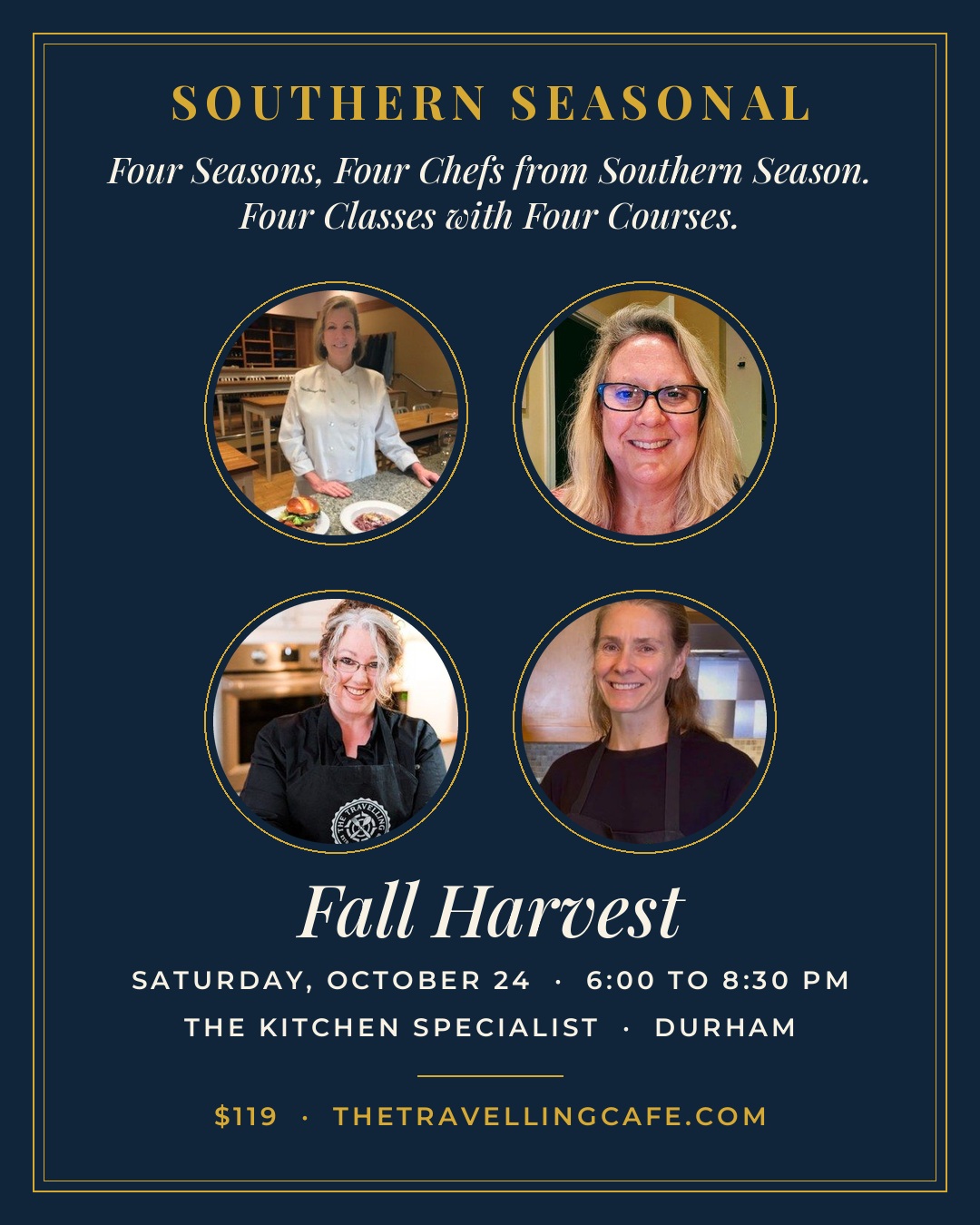
Southern Seasonal: Fall Harvest · Saturday, October 24
Four Seasons, Four Chefs from Southern Season. Four Classes with Four Courses. People love surprise courses.
6:00 to 8:30 pm at The Kitchen Specialist, 3407 University Dr, Durham, with Leslie Chartier, Caitlin Burke, Ellen Clevenger-Firley and Kim Calaway. Tickets are $119.
For 45 years, Southern Season was Chapel Hill’s gourmet market, and upstairs was The Cooking School at Southern Season, where chefs from all over the country taught in front of a full room. The store closed in January 2020, and the building was later torn down. In December 2024, Bill Arthur told the business side of that story for The Assembly in How Southern Season, a Chapel Hill Foodie Dream, Met Its End.
Leslie Chartier, founder of The Travelling Cafe, worked at the cooking school for its last two years. Today she and chefs from the school teach Southern Seasonal, a demonstration class held once a season. Their fall class is Saturday, October 24 in Durham. We asked her about the school, the people and why they never stopped cooking together.
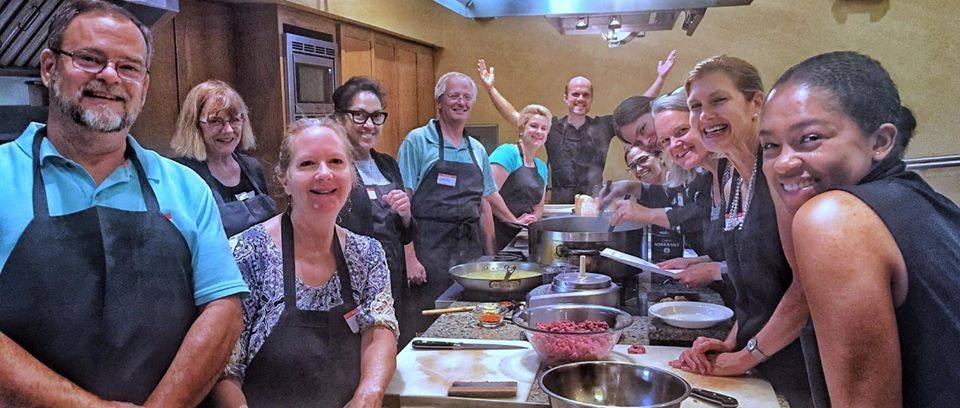
What do you remember about the first time you walked into the cooking school?
I remember how I felt and what I was thinking. I never heard of the concept before. As you walked up from the main floor of the store to the cooking school, you literally passed this hall of pictures of chefs from all over the country, including Ina Garten, who had taught there in previous years. Then there was a giant sign, and then I stepped in the opening of the school to look down, and it looked like nothing I’ve ever seen.
It was an auditorium style production kitchen, like you see on television. There were custom built tables at different heights going down to the kitchen, seating for almost 50, mirrors the whole stretch of the room, cameras, top-of-the-line cooking equipment. I was intrigued, overwhelmed and excited beyond my imagining to be able to potentially be a part of something like it.
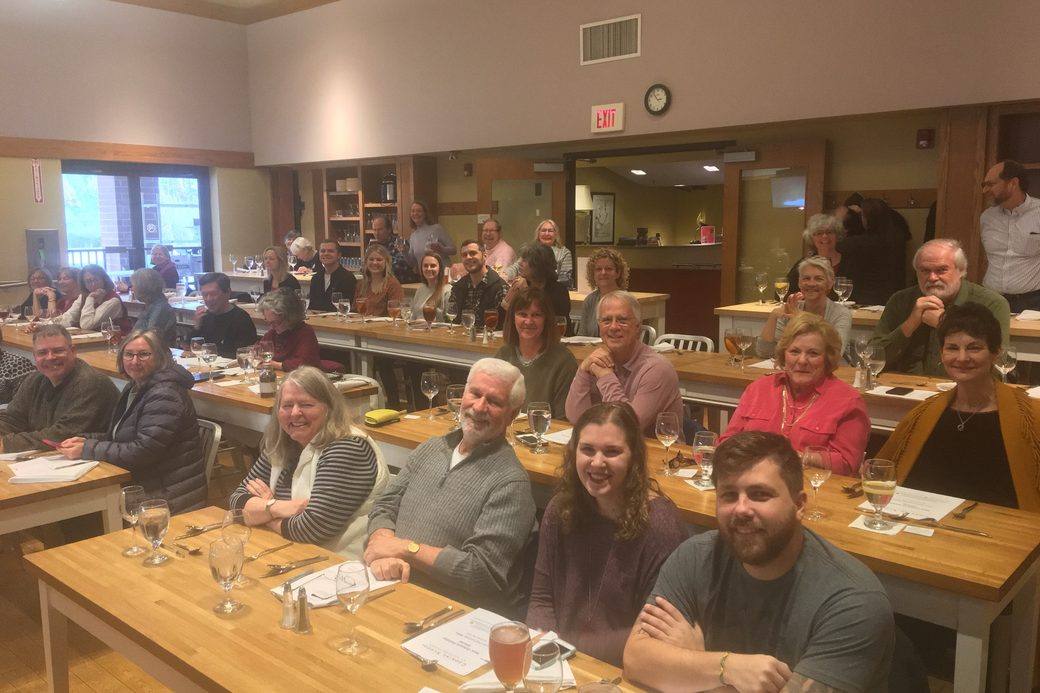
How did you end up there, and what was your job?
I was managing the café at Guglhupf in Durham at the time, but was looking for a change. I wanted to get back into the kitchen rather than managing from out front. There was an open position there as a cooking class lead. That position acted like a sous chef and a producer.
It was my job to make the class happen behind the scenes before the chef walked in the door: the procurement, the staff communication. Then, prior to the chef arriving, I managed a team of staff and volunteers to do all the prep work for the class. When the chef arrived, I became their sous chef and made sure their demonstration went off without a hitch. If I saw that in two steps of the recipe they would need a spatula that wasn’t out, I would get it beforehand. It was anticipating their needs while simultaneously plating each course and directing the person on the camera, the servers serving the wine between the courses, and the people washing the dishes.
I learned more from assisting those chefs in that two year span than I think I would’ve learned getting a four-year degree beyond my culinary training. My real schooling happened there. I was beyond privileged to learn from so many cookbook authors, local restaurant chefs and regional chefs. We had chefs coming in from Washington DC, from food magazines, from New England, from Atlanta, from Asheville. It was an amazing experience and I learned so much.
But the camaraderie is the biggest thing. The camaraderie between the staff and volunteers was so special, and it continues to this day.
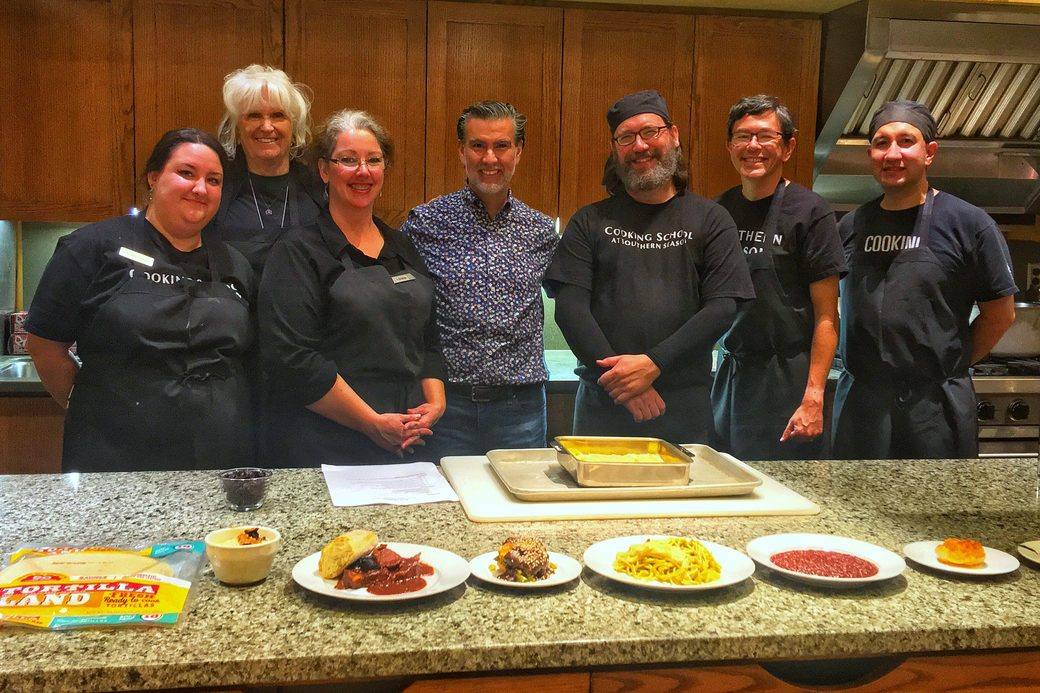
What was it like behind the scenes?
The camaraderie was huge. We would come 3 to 4 hours before the class and everyone would prep like crazy, because we were doing several courses plus wine and beverages for up to 50 people. That is a huge production. Then we would have to clean up afterwards. Then we would stop when we were finished and eat the leftovers together and drink the leftover wine together in a family meal, and just talk and share and enjoy each other, and talk about the class and what we’d learned and what we thought about the chef. It was a wonderful thing. A bunch of foodies, many who had volunteered there for years and years, like 20 years, and had seen so many people come through, and so many stories.
One of those stories comes from Chef Ellen Clevenger-Firley, one of the managers of the cooking school.
Chef Ellen remembers
Southern Season had a 48 seat demonstration kitchen with an outdoor porch and grill area. Fred Thompson, a local chef, columnist and cookbook author, came often to give cooking classes. One of his classes was on cooking and serving duck. We ordered 20 fresh duck breasts, brined, to be cooked on the outside grill.
I looked out to the porch to see black smoke billowing from the grill. The full grill was enveloped in fire. We saved 8 duck breasts. Fred took them in and proceeded to demonstrate how to thinly slice duck breasts (so 8 breasts could serve 50 people) and said how the ‘smokey flavor’ added depth of flavor to the dish. The class ended to great applause. After everyone left, Fred and all staff broke into uncontrolled laughter.
A truly good chef and teacher never lets on to his mistakes!
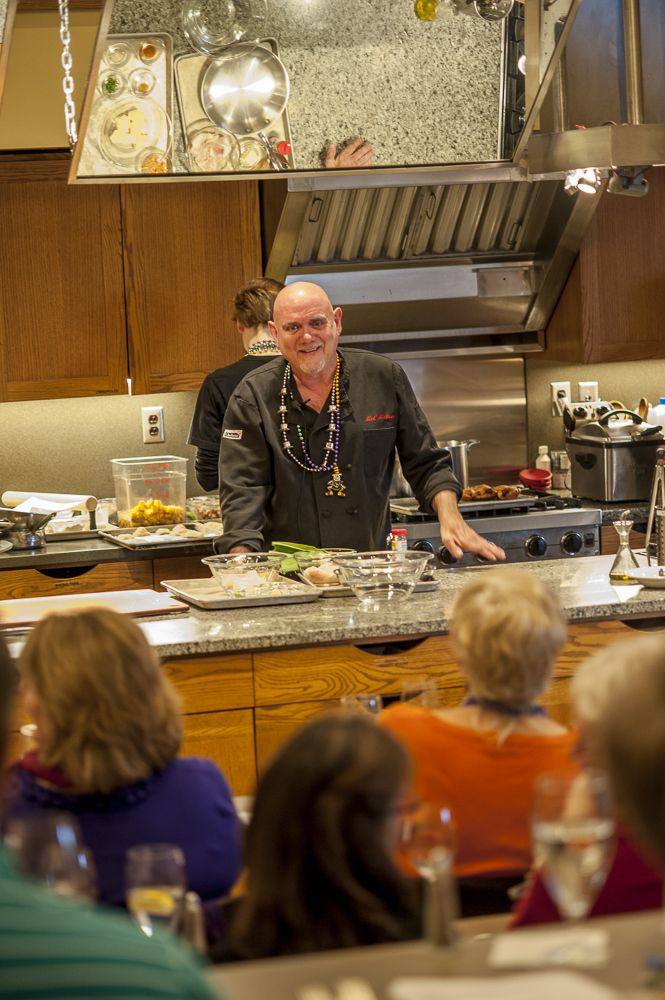
Which class do you remember most?
The class I remember the most was taught by Simone Saleh, the daughter of the owner of Sassool in Raleigh. She was the executive chef there. She taught Mediterranean food from where her family is from, from where she grew up and from what the restaurant serves. While I had eaten Mediterranean food, I’d never cooked it. Learning how to do a proper baba ghanoush, from salting the eggplants to grilling them to draining them, the amazing smokiness that came from that dish. It was utter deliciousness. I don’t think I ever got those grill pans completely clean after that, but I make it all the time now and I teach her methodology in my classes.
What was it like when you heard it was closing?
Well, first of all, I wasn’t surprised. None of us were surprised. Southern Season had gone through a bankruptcy and a sale after expanding a bit too quickly. The new owners wanted to make it more like their other stores, which were more like at-home retail stores, and what was lost was the character that made Southern Season a destination. The classes, the cooking store and the cheese shop started really becoming undervalued. When you’re one of the only cheese shops in the Triangle and there’s a fifth of the amount of cheese that used to be there, you have an idea something’s happening. We would also see different groups of people being shown through the store, and usually that means someone is looking for investors or to sell.
The one great thing the owner did was to let the entire staff know early on, probably in November, that they would be closing the store in January 2020. That gave all of us time to adjust and the ability to work through the holiday season, and I think that really helped with closure for a lot of us. At least it did for me.
Of course it’s beyond sad, but most things do have a life, especially things that are independently owned by real people and not corporations. It takes so much to keep something alive that began as someone’s vision and dream. Now when I’m doing private classes or dinner parties throughout the Triangle, they will ask how I got my start, and the moment I bring up Southern Season, so many people instantly make an exclamation like “I miss that place so much” or “I used to bring all my relatives that came into town to visit.” It went from being one man’s dream and vision to an experience which probably thousands and thousands of people experienced and loved. Once it sold to someone who did not have the same vision, you lose so much of the original, as hard as you try to keep it, and that’s what happened with Southern Season.
The final wave of grieving the passing of Southern Season was when we saw that section of University Mall being torn down years later. I live very close to it now in Chapel Hill. To see it sit empty for months with all the signage still on the side doors, I would drive by occasionally just to look in that window. And then when it was bulldozed, there was just another wave of grief and nostalgia that came over all of us. You could see it in the comments on the Chapel Hill Carrboro foodies Facebook page. University Place has done a great job of rebuilding that section to make it open and walkable, with lots of new little shops. Jeni’s ice cream is my favorite.
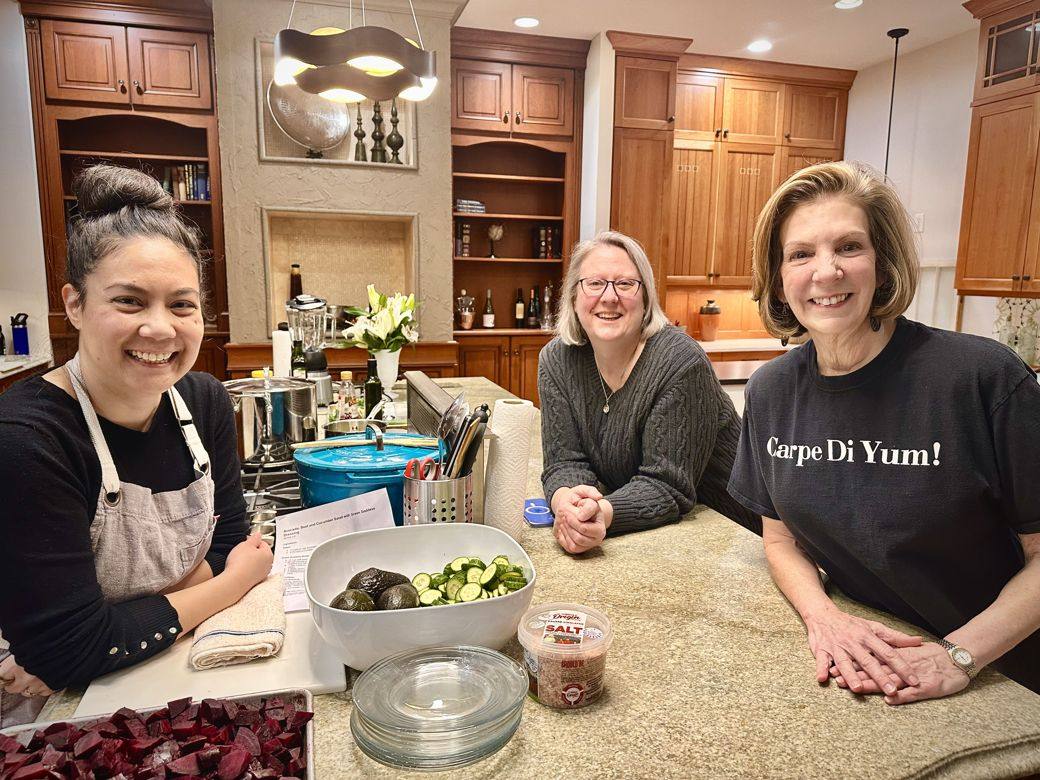
Why did you all keep cooking together, and what was the first time back like?
None of us wanted it to just die with the building. We wanted to keep the spirit of the cooking school at Southern Season alive.
We’ve actually been doing this for five years now. When we first came back together it was during the pandemic, so we were all nervous. Most of us hadn’t talked in a long time, and getting people together was nerve-racking, but it was a lot of fun. Most of the crowd that came to that first one at my old Pittsboro studio were Southern Season staff and volunteers and people in the Pittsboro community that used to go.
Athina Sgambati and Kim Calaway organize get-togethers a couple of times a year for the large group, and there is a group of the volunteers that get together and do a supper club monthly. These cooking classes The Travelling Cafe does are another part of that: getting chefs together to do that demonstration style in a little more relaxed way than at Southern Season, but just to re-establish that type of atmosphere and experience. It’s a lot of fun to be able to do that together.
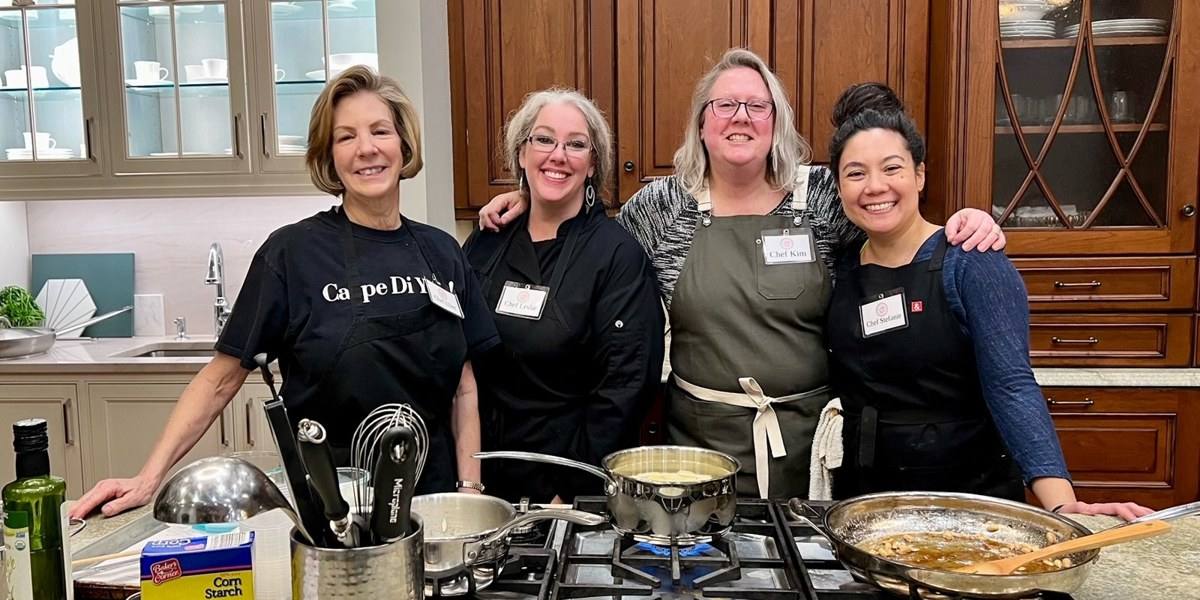
It has been fun each time, and the Southern Seasonals now are my favorites, because everyone knows what they’re doing. They come prepared. They’re seasoned professionals, and I’m still learning from them after all this time. Ellen travels constantly, so she’s always bringing things back with her. Kim is so connected to the restaurant community and keeps up with all of the latest influencer stuff. Caitlin is a wealth of information on all kinds of topics, especially food chemistry. Stefanie and I share a love of holistic, food as medicine topics. So it’s always a lot of fun.
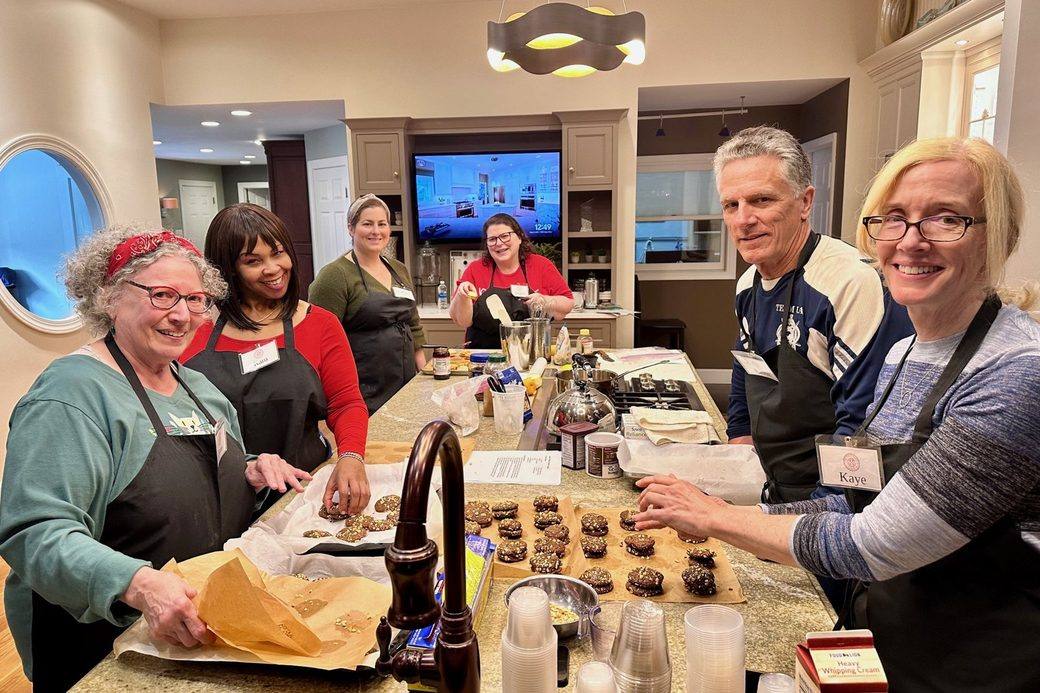
If someone has never been to one of these classes, what do you hope they leave with?
It’s my hope that they walk away just feeling great about life. That they walk away feeling built up after watching people create food and learning not just tips and tricks but the whys behind techniques. That they experience passion, excellent food and healing fellowship.
It’s an active demonstration format. The first chef teaches the first course, then everyone sits down to eat together, and you’re sitting down with people you’ve never met before, because we mix people up at the tables. There are multiple chefs and multiple courses, and you’re up talking with them during it. It’s very informal. You can speak to all the chefs and each other and ask questions during the demonstrations. Sometimes the chefs will ask for a volunteer to help show something, so there’s a lot of interaction between everyone. By the end of most of these classes, people make connections and they’re exchanging contact information.
That’s my hope for all of our classes, not just the Southern Seasonal classes, and it’s what I see happening. People find real connection. They are transported for a period of time and fully immersed in an experience that leaves them feeling better than when they came in, and with more connections to other humans.
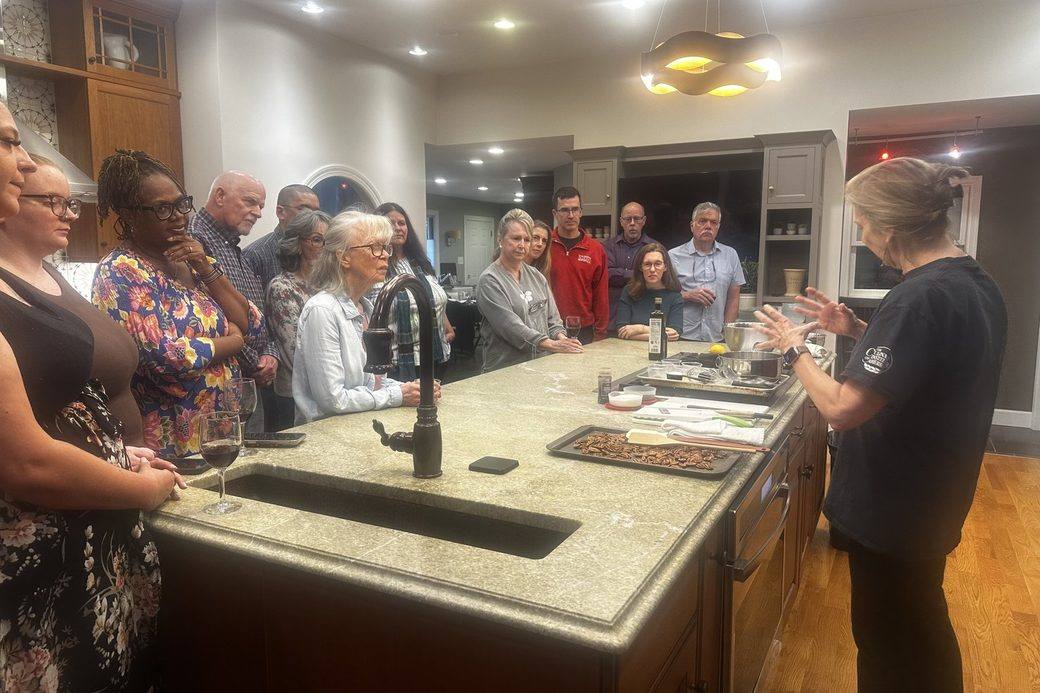
Southern Seasonal
Southern Seasonal: Fall Harvest is Saturday, October 24, 6:00 to 8:30 pm at The Kitchen Specialist, 3407 University Dr, Durham, with Leslie Chartier, Caitlin Burke, Ellen Clevenger-Firley and Kim Calaway. Tickets are $119.
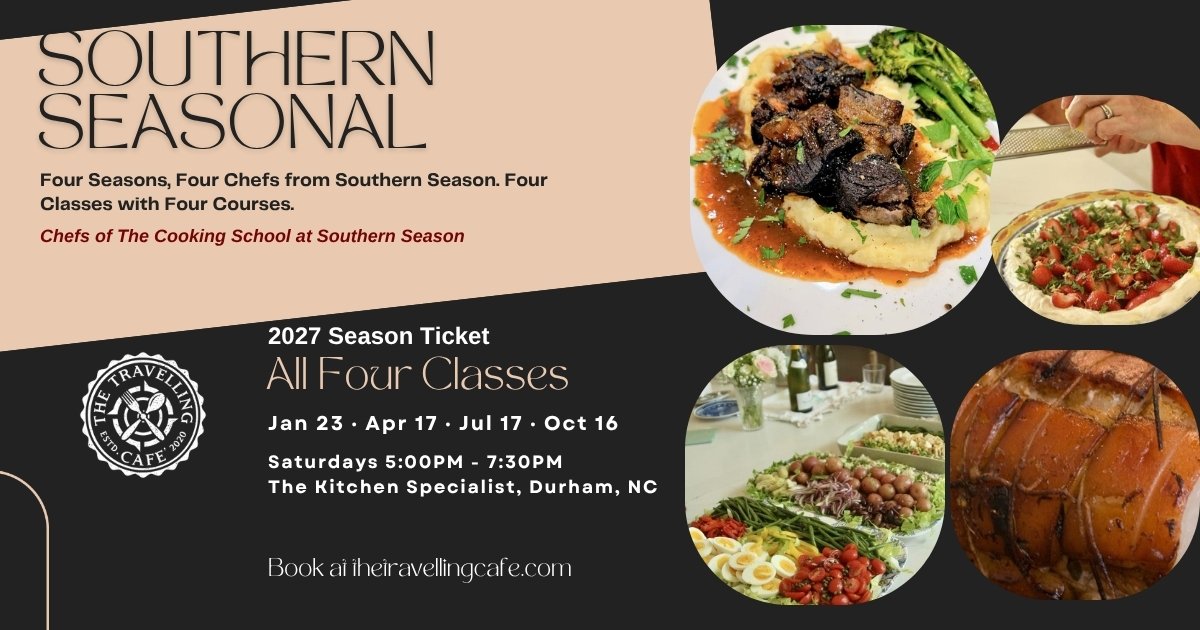
The 2027 season runs four Saturdays at 5:00 pm: January 23, April 17, July 17 and October 16. Each class is $119, or $429 for a season ticket to all four.
Join our mailing list for classes and updates.